JAMstack flips traditional web development on its head. Instead of generating pages on a server at request time, everything is pre-built, globally distributed, and served as static files. The result is a web that’s faster, cheaper, and vastly more secure.
What Does JAM Stand For?
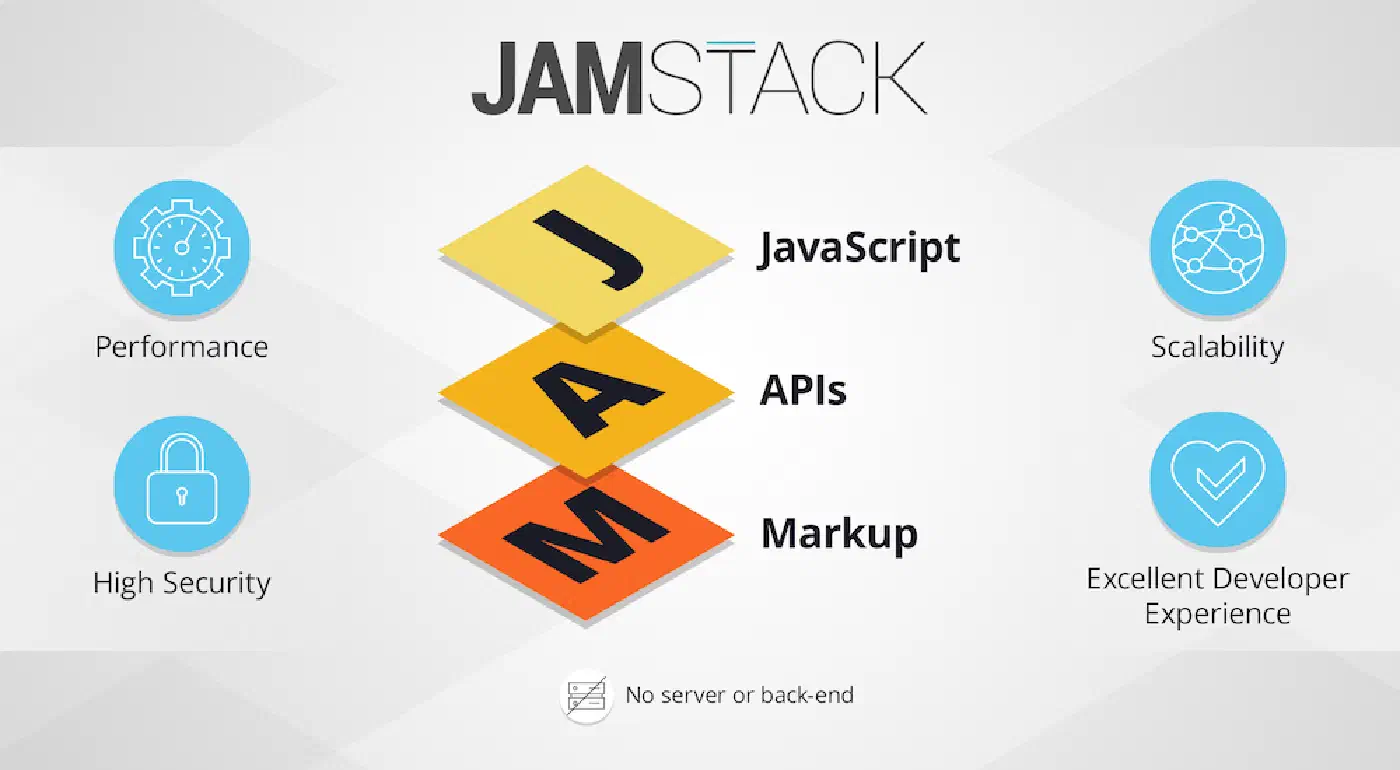
JAM is an acronym for JavaScript, APIs, and Markup:
- JavaScript — Handles all dynamic behaviour on the client side. This can be vanilla JS, React, Vue, or any other framework.
- APIs — Server-side logic is abstracted into reusable, third-party APIs accessed over HTTPS (auth, payments, search, comments, etc.).
- Markup — HTML is pre-rendered at build time, typically from Markdown via a static site generator like Hugo.
The key principle: no web server renders HTML at request time. Pages are already built and sitting on a CDN waiting to be served.
How It Differs from Traditional Stacks
| Traditional (e.g. LAMP) | JAMstack | |
|---|---|---|
| HTML generated | At request time | At build time |
| Hosting | Web server (Apache, Nginx) | CDN (Netlify, Cloudflare) |
| Scaling | Requires server scaling | Automatic (CDN edge nodes) |
| Attack surface | Database + server exposed | No server, no database |
| Cost | Server costs | Often free for small sites |
In a traditional WordPress site, every page load triggers a PHP process, a database query, and HTML assembly — all in milliseconds, but under load it adds up. In a JAMstack site, the HTML is already there.
The Build Process
The typical JAMstack workflow looks like this:
Developer pushes code
       ↓
CI/CD pipeline triggers (e.g. GitHub Actions, Netlify)
       ↓
Static Site Generator builds all pages (Hugo, Next.js, Astro)
       ↓
Output deployed to CDN edge nodes worldwide
       ↓
User requests → served directly from nearest edge node
Hugo is particularly well-suited here — it can build thousands of pages in under a second, keeping CI build times minimal.
Where Does Dynamic Content Fit?
JAMstack doesn’t mean no dynamic content — it means dynamic content is handled differently:
- Comments → Disqus, Utterances (GitHub Issues), or Staticman
- Search → Algolia, Pagefind (runs at build time)
- Forms → Netlify Forms, Formspree
- Auth → Auth0, Netlify Identity
- E-commerce → Snipcart, Shopify Storefront API
Each concern is delegated to a best-in-class API, rather than a monolithic backend doing everything.
Why Use JAMstack?
Performance — Pre-built HTML + CDN = sub-100ms time-to-first-byte globally.
Security — No database, no server-side runtime, no attack surface. The most a compromised CDN can serve is static HTML.
Developer experience — Git-based workflows, instant rollbacks, preview deployments, and no server to manage.
Cost — Many JAMstack hosts (Netlify, Cloudflare Pages, GitHub Pages) have generous free tiers that handle significant traffic.
Conclusion
JAMstack isn’t a framework — it’s an architectural philosophy. By decoupling the front end from the back end, pre-building all markup, and delegating dynamic functionality to APIs, you get a web stack that is naturally fast, secure, and easy to scale.
Hugo is one of the best entry points into JAMstack: it’s a single binary, has no runtime dependencies, and produces optimised HTML in milliseconds.
References: